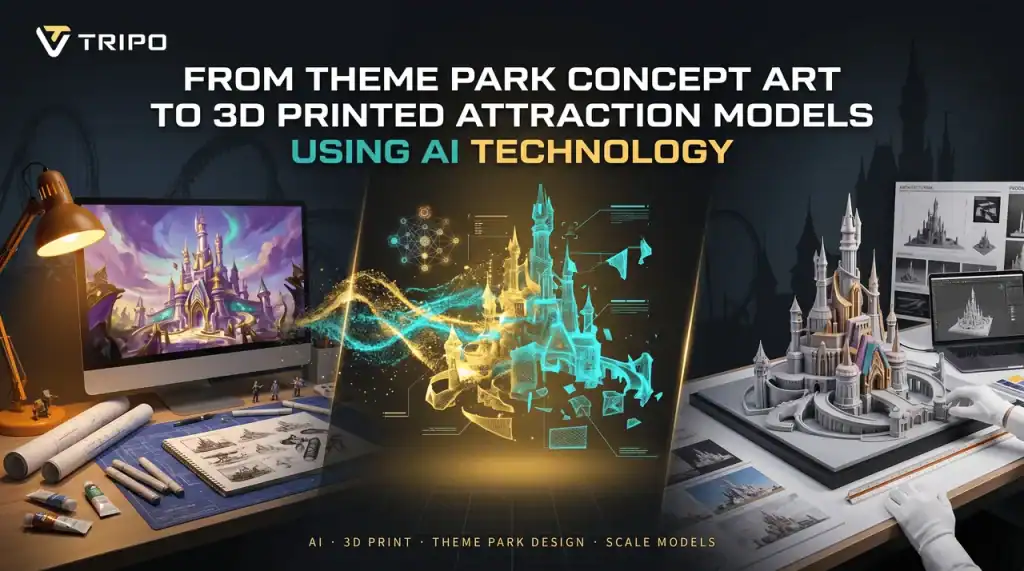
All amazing theme park attractions start as artwork. And long before any one of your guests gets to experience any thrill ride or immersive attraction, or a complete area of the theme park, designers may have spent countless hours creating concept artwork that illustrates their vision. This artwork helps convey the intended mood, story, and style of an attraction long before any construction of the physical attraction will actually take place.
Traditionally, converting artwork to physical 3D models has been a long and labor-intensive process. Fortunately, with the introduction of 3D AI and platforms like Tripo 3D, creating highly detailed 3D models from concept artwork can now happen quickly, allowing designers to prototype, test and even produce 3D printed attraction models for pitches, reviews, and planning.
Keep reading to learn about how AI-based 3D Modeling enables theme park designers to move from a vision to a tangible prototype much faster than in the past.

When a drawing becomes the start of something great
Theme park concept art is about more than just what the attraction looks like.
The sketches establish a sense of mood and tone and determine a ride’s style. Regardless if they are conceptualizing a medieval castle, futuristic launch coaster, dining attraction, or interactive experience, the idea that was put to paper becomes the foundational artwork for the subsequent project development process.
There’s a challenge: these two-dimensional illustrations can’t fully convey the sense of a ride’s scale and physical structure from the guest’s perspective.
Tripo 3D bridges that gap by turning visionary illustrations into rich three-dimensional assets.
Why physical attraction models still matter
Even in the age of digital technology, physical attraction models play a crucial role.
Miniature attraction models help stakeholders:
-
Envision a project’s scale.
-
Review design concepts.
-
Understand spatial relationships.
-
Convey ideas effectively during presentations.
-
Explore alternative design possibilities.
The act of physically interacting with a model generally aids in understanding a project far better than looking at a flat design render alone.
Tripo 3D helps simplify the creation process of these important physical models.
Imagination made manifest
Theme park attractions are an exercise in storytelling.
Every element of an attraction, whether it’s the architecture, the pathways, the vehicles, or any other visual element, contributes to the story and overall guest experience. However, designers need to understand how all these various elements will fit together and translate into physical forms before construction can truly begin.
Image to 3D models can help communicate a more immersive view of how a project will turn out, allowing designers to refine the layout, develop solutions for identified challenges and make adjustments to aesthetic elements before dedicating additional time and resources to planning the physical build.
Tripo 3D is capable of speeding up this critical process by creating digital assets that can be evaluated from all angles.
Streamlining collaboration
Themes park attractions involve complex collaboration among architects, engineers, concept artists, designers and other professionals. Each profession contributes a unique viewpoint. Interactive 3D models can be used as an essential, unifying visual reference throughout the development process to prevent misinterpretations and facilitate better collaboration.
By enabling the rapid generation of detailed 3D models, Tripo 3D accelerates team progress and builds consensus for design decisions.
Technology supports artistry
Modern theme park creations integrate creative vision with sophisticated technology. While artistry will always be fundamental to designing immersive experiences, technological innovations will greatly streamline development processes and eliminate tedious tasks, allowing designers to focus on creative storytelling.
Tripo 3D streamlines this workflow by quickly generating three-dimensional models of attractions.
Fostering creativity through iteration
Innovation drives every breakthrough attraction. The design process requires creative exploration and iteration, with multiple concepts typically being evaluated before a final vision is achieved. Accelerated modeling, such as that provided by Tripo 3D, provides more opportunities for the iteration process to unfold in the conceptual stage.
This helps promote further creativity in a project that otherwise would continue moving at a slower pace.
Streamlining the Production of 3D Printed Prototypes
Traditional model making could be labor-intensive and time-consuming. With AI models and simple steps, a prototype can now be 3D printed without extensive manual work or requiring skilled modelers.
Streamlined creation for 3D printed prototypes, and immediate export options like image to STL format eliminate significant labor and make the concept development phase far more efficient. This allows you to put your focus on the guest experience.
Turning concept art into a ride in four simple steps
After your concept art is developed, Tripo 3D streamlines the transformation process into a detailed 3D model.
Step 1: Upload your art
Open the Tripo AI interface and select your creation method, then simply upload your concept art files (JPG, PNG, WEBP formats are compatible). Images with higher resolution and finer detail work best for rendering more precise results.

Step 2: Customize your settings
Set your mesh quality and texture quality based on what works best for your individual project’s needs. High detail settings are excellent for preserving architectural details and the intricacies of an attraction’s themed décor.

Step 3: Generate and refine
Once generated, use the Tripo AI’s robust refinement tools to adjust the texture detail of your attraction, extract and separate components, or modify the geometry for further precision.

Step 4: Export your model
Save your created 3D model in your preferred file format for immediate use in presentations, visualization tools, or design software (STL, OBJ, FBX, GLB, and USD are all supported).

Concept illustrations to ready-to-present visuals
Theme park development can involve gaining approvals from investors, executives and partners for large projects. The visual impact and presentation of any project can play an extremely important role in helping get projects approved and funded. With image-to-3D technologies, a concept can be brought to life by making the most detailed and compelling visualizations.
You can provide tangible physical representations that can aid stakeholders in better visualizing the size and appearance of the attraction.
Quicker approvals
It’s easier to understand any design when there’s a clear, physical or digital visualization. When the design concept can be presented with a visual reference that eliminates confusion, approval may come more quickly. Tripo 3D can help ensure the attraction project moves smoothly through the development cycle.
Realizing theme park visions
The development of an attraction begins with an idea, but making that idea a tangible reality is crucial to the design process. By enabling concept artists to convert sketches into detailed digital 3D models, Tripo 3D allows for better visualization and the creation of physical prototypes that are essential for planning and development.
Tripo 3D supports every project from thematic lands to highly interactive attractions by bridging the gap between creativity and reality through rapid 3D model generation. By combining innovative AI technologies with strong visual storytelling, design teams are more efficient than ever.
Are you looking to transform your theme park concept art into 3D printed attraction models? Discover how Tripo 3D can help bring your next major idea to life.

Ingénieur passionné d'intelligence artificielle et développeur Python. Fondateur de la newsletter "la-minute-ia.fr", je décrypte chaque semaine l'actualité de l'IA. Digital nomad dans l'âme, je partage mon temps entre développement, veille technologique et découverte du monde.
Latest posts by Mathieu (see all)