

Digital growth is the disciplined use of technology, data, digital channels and organizational capability to create measurable business growth. It is not limited to running more ads, launching a new website or buying software. The question is simple: does digital activity help the business acquire customers, serve them better, expand reach, improve efficiency and adapt faster than competitors?
For leaders, the value of the concept is strategic. Digital growth connects revenue, customer experience, operations and culture. It turns digital from a set of disconnected initiatives into a growth system that can be measured, improved and scaled.
What digital growth really means
Digital growth describes how an organization creates value through digital capabilities. Those capabilities can include ecommerce, CRM, analytics, automation, content, paid media, product platforms, self-service portals, data infrastructure and AI-assisted workflows. The tools matter, but they are not the whole story. Growth comes from how those tools support business goals.
Digital growth is broader than digital marketing
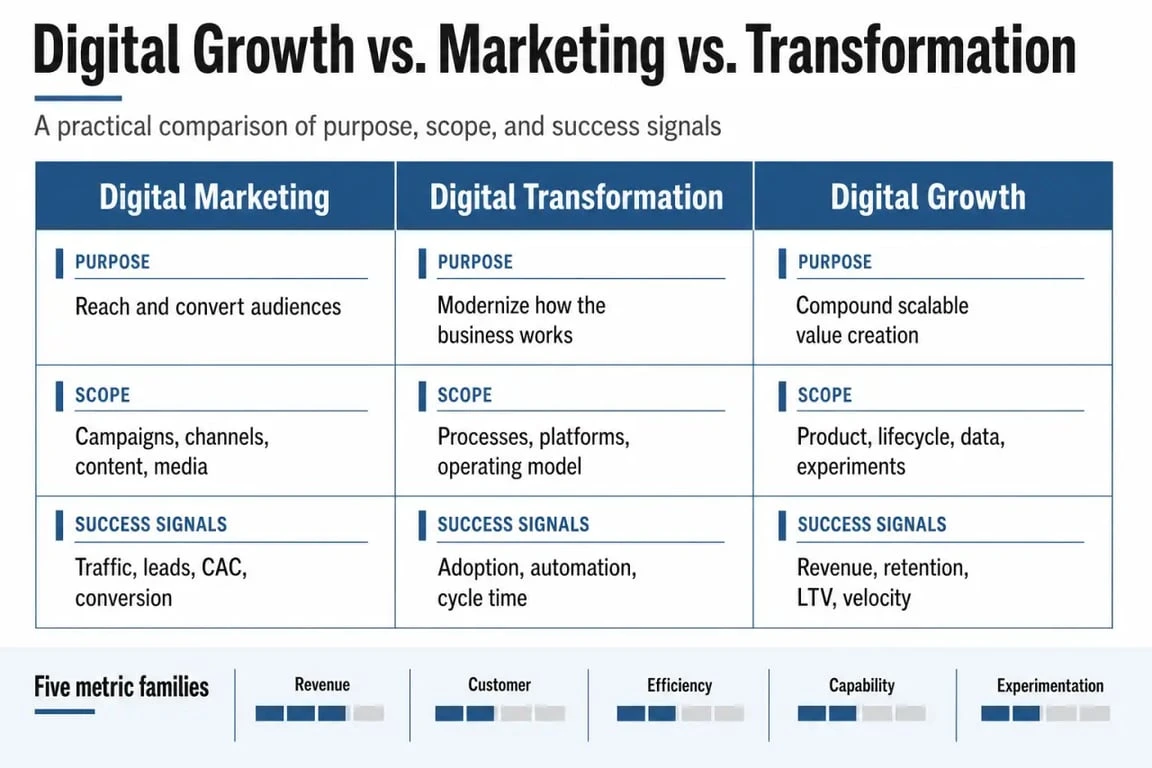
Digital marketing focuses on visibility, traffic, leads, campaigns and conversion. It is essential, but it is not the full system. A company can generate strong traffic and still fall short on digital growth if sales handoff is weak, onboarding is slow, customer data is fragmented or retention is ignored.
Digital growth includes marketing, but it also includes product experience, customer service, operational efficiency, sales enablement and strategic planning. It asks whether digital channels improve the entire customer journey, not just the top of the funnel.
Digital growth is not the same as digital transformation
Digital transformation is often about changing processes, systems and operating models. Digital growth is more outcome-oriented. It looks at whether those changes increase market reach, revenue potential, customer engagement, resilience or profitability. Transformation may be the journey; growth is the evidence that the journey creates value.
| Concept | Main focus | Typical question |
|---|---|---|
| Digital marketing | Acquisition, awareness, engagement and conversion | How do we attract and convert more customers online? |
| Digital transformation | Systems, processes, operating model and technology adoption | How do we modernize the way the business works? |
| Digital growth | Business value created through digital capabilities | How does digital make the business grow, scale and adapt? |
Why digital growth matters for business performance
Digital growth matters because customers now research, compare, buy, review and seek support through digital touchpoints long before they speak to a company directly. If those touchpoints are weak, slow or disconnected, the business loses trust before a sales conversation even begins. Trust is built or lost early.
It expands reach without relying only on geography
Digital channels cut the limits of location. A business that once depended on foot traffic, local referrals or regional sales teams can reach wider markets through search, social platforms, marketplaces, content, partnerships and digital service delivery. This does not mean every company should chase a global audience. It means the company can choose markets more deliberately and test demand faster.
More channels, more dashboards and more automation can create the impression of progress, but the organization still needs a clear north: the customer segment it wants to serve, the value proposition it wants to sharpen and the business outcome it wants to improve. Without that direction, teams optimize isolated metrics while drifting away from strategic growth.
It improves efficiency and resilience
Automation of business processes can reduce repetitive manual work, shorten response times and make operations more consistent. Examples include automated lead routing, self-service appointment booking, digital onboarding, triggered customer communications and integrated reporting. These improvements do not only save time; they also make the business less dependent on fragile manual routines.
Digital maturity also supports resilience. When markets shift, organizations with strong data, flexible systems and cross-functional collaboration can adjust messaging, pricing, offers and service models faster. Digital growth is not only about accelerating in good conditions, it is also about staying responsive in uncertain ones.
The 12 key areas that make digital growth work
Digital growth becomes manageable when it is broken into practical areas of focus. These 12 areas help leaders see whether they are building a real growth system or simply adding tools to an old operating model.
- Strategic alignment: digital investments must connect to revenue, customer experience, efficiency or market expansion.
- Customer insight: teams need a clear view of needs, objections, behaviors and journey friction.
- Digital channels: search, social, email, marketplaces, apps and platforms should each play a defined role.
- Data quality: decisions depend on reliable, accessible and well-structured information.
- Technology integration: systems must work together instead of creating new silos.
- Customer experience optimization: every digital touchpoint should reduce effort and increase confidence.
- Conversion systems: landing pages, forms, checkout, calls to action and sales handoff must be tested and improved.
- Retention and loyalty: growth is stronger when digital tools support repeat purchase, education and service.
- Process automation: routine tasks should be simplified where automation improves speed and consistency.
- Digital skills: teams need training, not only platforms.
- Experimentation: rapid prototyping helps validate ideas before large investments.
- Governance and security: privacy, cybersecurity and ownership rules protect the growth system.
The danger of incremental improvement without transformation
Many organizations improve individual digital tactics without changing the underlying business model. They redesign the website, increase media spend or add a dashboard, but customer data remains scattered, teams still work in silos and decisions still rely on hierarchy rather than evidence. That can produce small gains, but it rarely creates durable competitive advantage.
A more mature approach asks where digital can change the economics of the business. Can onboarding be 10X faster? Can self-service reduce support pressure? Can digital education shorten the sales cycle? Can a larger share of revenue come from digital channels, even a target such as 60 percent in a business where that is realistic? These questions push teams beyond cosmetic modernization.
How to measure digital growth without chasing vanity metrics
Digital growth should be measured with a mix of performance indicators and maturity indicators. Performance metrics show what is happening now. Maturity metrics show whether the organization is becoming more capable of growing digitally over time.
| Metric type | Examples | What it reveals |
|---|---|---|
| Revenue metrics | Digital revenue percentage, online sales, pipeline influenced by digital channels | Whether digital activity contributes directly to business outcomes |
| Customer metrics | Customer digital engagement rates, repeat visits, retention, satisfaction signals | Whether customers find digital touchpoints useful and trustworthy |
| Efficiency metrics | Automation levels, cost per acquisition, response time, process cycle time | Whether digital reduces waste and improves execution speed |
| Capability metrics | Technology investment ratio, data accessibility, cross-functional collaboration | Whether the business is building capacity for future growth |
| Experimentation metrics | Tests launched, learning velocity, prototype-to-launch rate | Whether the organization can learn and adapt quickly |
Qualitative signals matter too
Not every sign of digital growth appears immediately in revenue. A sales team that finally trusts CRM data, a support team that sees fewer repeated questions, or a marketing team that can explain which channels influence pipeline are all signs of maturity. Qualitative assessment is especially useful when digital growth is still early and financial results need time to appear.
The key is to avoid measuring everything equally. A useful dashboard should show a small set of indicators tied to the company’s priorities. If the priority is market expansion, track reach, qualified demand and digital conversion by segment. If the priority is efficiency, track automation, cycle time and cost reduction. If the priority is customer experience, track engagement, satisfaction and friction points.
Challenges, risks and strategic takeaways
The biggest barriers to digital growth are rarely technical alone. Skills gaps, unclear ownership, cultural resistance, cybersecurity concerns, privacy requirements and disconnected systems can slow progress more than the choice of platform.
Common reasons digital growth strategies fail
Strategies often fail when digital is treated as a department rather than a business capability. Marketing may own campaigns, IT may own systems and sales may own customer relationships, but digital growth requires shared accountability. Without cross-functional collaboration, each team optimizes its own area while the customer experiences friction between them.
Another common problem is investing in technology before clarifying the growth model. A new platform cannot compensate for a weak offer, poor customer insight or unclear positioning. Technology should amplify a sound strategy, not replace one.
Where to start
The best starting point is not always the largest project. Begin where digital can remove a visible constraint: a slow manual process, a high-friction customer journey, a weak conversion point, a missing data connection or a market segment that is difficult to reach through traditional channels.
- Define the business outcome first: revenue, efficiency, retention, reach or resilience.
- Map the customer journey and identify the moments where digital can reduce effort.
- Audit the systems and data needed to support that journey.
- Choose a small number of metrics that prove progress.
- Run controlled experiments before scaling investment.
- Build digital skills and governance alongside tools.
Digital growth is strongest when it becomes a habit of strategic learning. The companies that benefit most are not simply the ones with the newest tools, but the ones that align technology, data, people and customer value into a repeatable growth engine.