
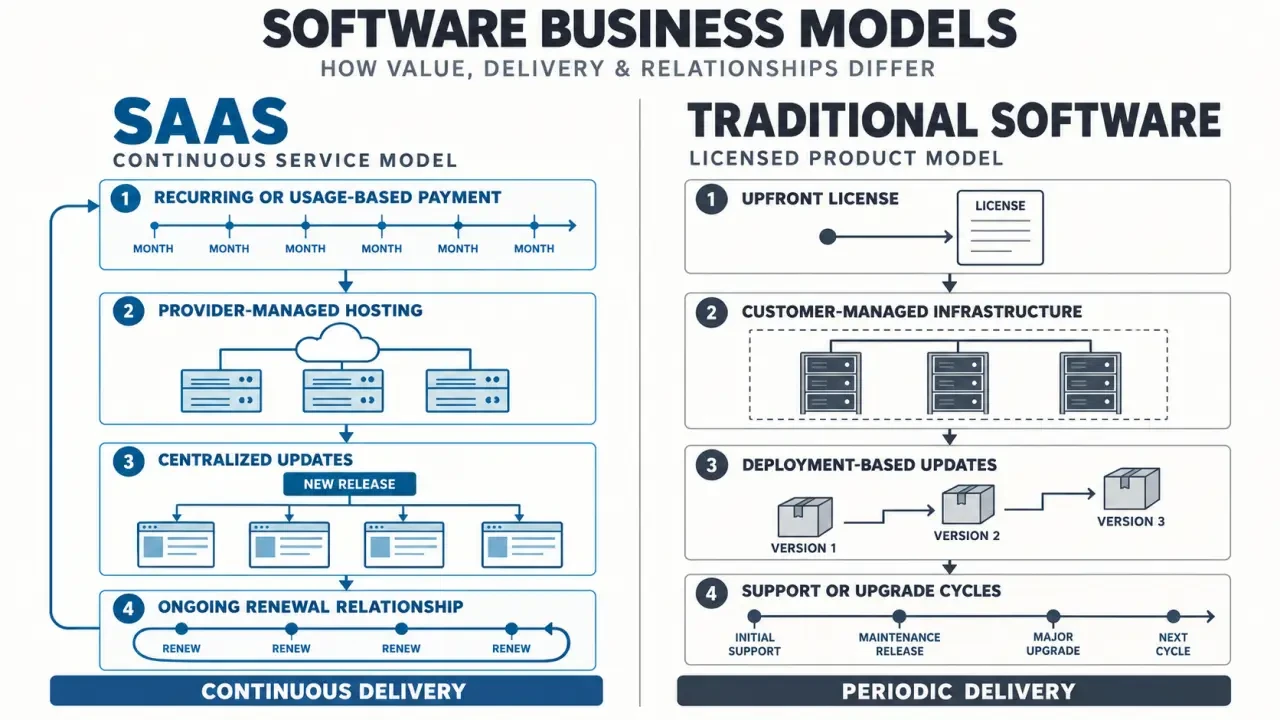
The software as a service business model delivers cloud-hosted software over the internet, usually through a monthly or annual subscription. Customers pay for continued access rather than buying a perpetual license, while the provider manages hosting, maintenance, and updates. The commercial advantage is recurring revenue; the challenge is earning renewals while keeping acquisition and service costs under control.
What customers buy—and what the provider must deliver
SaaS customers typically access an application through a web browser, although some services also offer desktop or mobile applications. The provider operates the underlying software infrastructure. Customers still need to manage users, permissions, configuration, and their own data practices, but they avoid much of the work associated with running application servers.
SaaS Metrics Calculator
Enter your monthly figures to calculate key recurring-revenue and acquisition metrics.
Salesforce illustrates SaaS for customer relationship management, Zendesk for customer service, and Meet Edgar for social media scheduling. Their functions differ, but the underlying exchange is similar: continued payment supports continued access to a managed application.
| Dimension | SaaS | Traditional installed software |
|---|---|---|
| Payment | Usually subscription or usage-based | Often an upfront license, sometimes with maintenance fees |
| Hosting | Managed by the provider | Usually managed by the customer or its IT partner |
| Updates | Delivered centrally by the provider | Often require customer-managed deployment |
| Customer relationship | Ongoing service and renewal cycle | Often centered on purchase, support, and upgrades |
| Main customer risk | Service dependence, price changes, and migration difficulty | Maintenance burden and infrastructure requirements |
These are typical distinctions, not absolute rules: installed software can also use subscription licensing. SaaS describes a delivery and operating model, not merely a monthly payment option. Its benefits depend on reliable access, useful updates, security, and support—not billing frequency alone.
Choose pricing that follows customer value
A sustainable pricing model gives customers a clear reason to pay more as the value they receive increases. Charging by user works when additional users gain meaningful benefits. Usage-based billing fits products whose consumption varies substantially. Neither approach works well if customers cannot understand or forecast their bills.
| Pricing approach | How it works | Main trade-off |
|---|---|---|
| Flat subscription | A fixed recurring price for a defined package | Simple, but heavy users may cost more to serve |
| Seat-based | Charges per user or licensed seat | Scales with adoption but can discourage adding users |
| Tiered | Packages differ by features, limits, or service | Supports different segments but requires clear boundaries |
| Usage-based | Charges follow consumption, such as storage or processing | Aligns with activity but reduces bill predictability |
| Hybrid | A base subscription plus usage charges | Balances committed revenue with variable consumption |
| Freemium | Free access with paid upgrades | Encourages adoption but creates costs before conversion |
| Add-ons | Optional modules supplement a core plan | Enables expansion but can complicate purchasing |
Freemium is an acquisition and conversion approach rather than a revenue stream by itself. It needs a useful free experience and a persuasive upgrade trigger. Add-ons should represent distinct value, rather than making the core product feel incomplete.
Monthly billing lowers the initial commitment. Annual prepayment improves near-term cash collection but creates an obligation to deliver service throughout the contract. Before introducing either, define how upgrades, downgrades, cancellations, credits, and usage overages will work.
Measure retention and unit economics, not just subscriptions
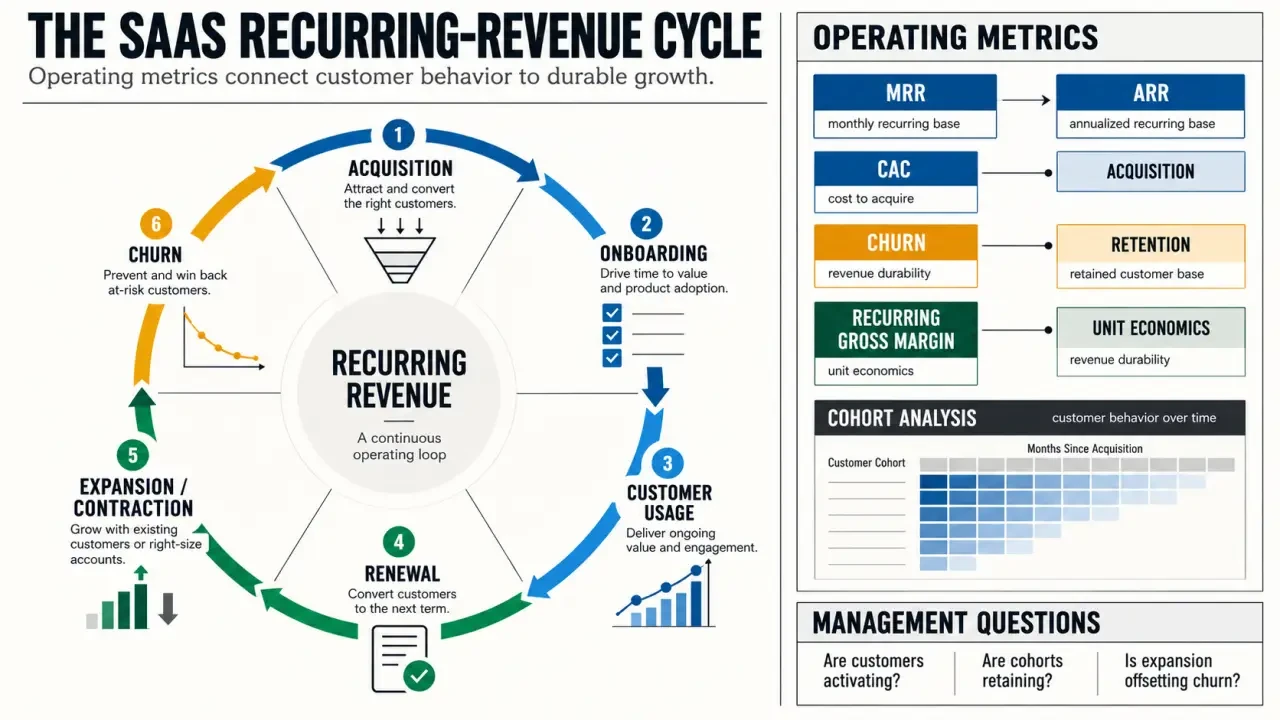
Recurring revenue becomes valuable when customers stay and the cost of serving them leaves room to fund the business. A growing subscriber count can conceal expensive acquisition, shrinking accounts, or deteriorating margins. The essential SaaS metrics must therefore be read together.
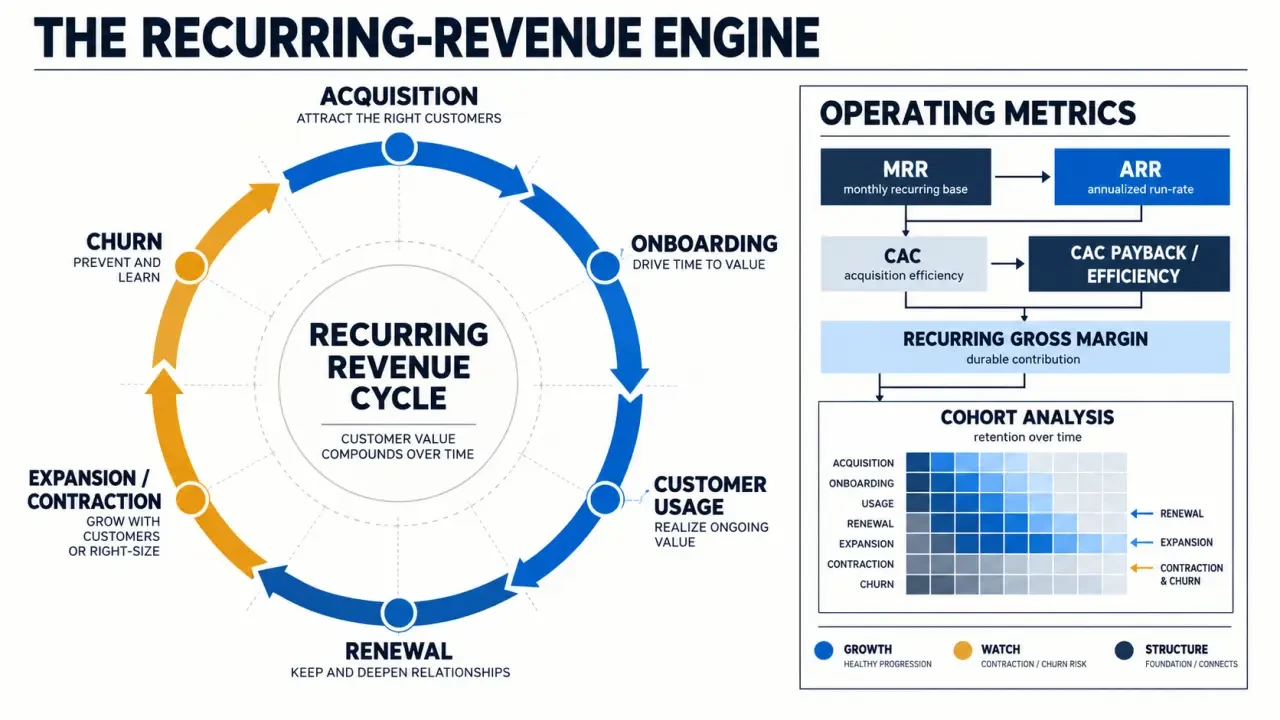
- Monthly recurring revenue (MRR): monthly-normalized recurring subscription revenue, excluding one-time fees.
- Annual recurring revenue (ARR): annualized recurring revenue. For a consistent subscription base, ARR equals MRR multiplied by 12; it is not necessarily recognized annual revenue.
- Churn: customer or recurring-revenue losses over a defined period. Customer churn and revenue churn answer different questions.
- Customer acquisition cost (CAC): relevant sales and marketing acquisition costs divided by customers acquired, using consistent periods and attribution.
- Customer lifetime value (LTV): estimated gross profit over the customer relationship. Early estimates are uncertain when retention history is short.
- Recurring gross margin: recurring revenue less the direct costs of delivering that service, divided by recurring revenue. This is not operating profit.
Track expansion separately from losses. Starting ARR minus churn, plus new recurring contracts and expansion, minus contraction, produces ending ARR when all components use consistent definitions. Net revenue retention isolates what happens within the existing customer base, including expansion, contraction, and churn.
Treat each signup cohort as a separate window onto the business. Looking through one window at a time—customers acquired in the same month, through the same channel, or on the same plan—reveals problems an aggregate dashboard hides. Strong acquisition can mask poor renewals among earlier customers; cohort analysis shows whether the product is retaining value or simply replacing departures.
Also monitor acquisition payback and a clearly defined growth efficiency ratio, such as net new ARR relative to sales and marketing spending. State the formula and timing: similarly named ratios are not always calculated alike. There is no single healthy benchmark that applies equally to every customer segment and sales model.
Build operations that can survive growth
Startup: prove a repeated need before scaling acquisition
Start with a specific customer problem, a usable product, and evidence that customers return because it helps them. Observe onboarding, time to first useful outcome, support requests, and renewal behavior. A self-service product may suit simpler purchases; complex deployments may require sales assistance, implementation, and customer success support.
Hypergrowth: capacity and cash become constraints
Rapid growth increases demands on compute, storage, bandwidth, security, and staffing. Cloud delivery makes expansion possible without shipping individual installations, but scalable delivery does not mean cost-free delivery. Monitor service costs by customer or workload so that pricing reflects expensive consumption.
Operational readiness also includes backups, tested recovery procedures, access controls, incident response, and clear service commitments. Acquisition spending may precede subscription collections, so even a promising business can need substantial working capital.
Stable operations: protect margins without neglecting the product
A mature SaaS business can generate dependable cash flow, but it still needs maintenance, security work, support, and product investment. Billing and finance systems must handle subscription changes and revenue recognition correctly. Cash received upfront is not automatically revenue earned immediately; recognition generally follows service delivery under the applicable accounting rules. Traditional transaction-focused systems may need additional subscription-finance capabilities.
Evaluate a SaaS business beyond its ARR headline
For founders and prospective buyers, attractiveness comes from durable customer value and transferable operations—not subscriptions alone. Recurring contracts improve visibility, but cancellations, customer concentration, technical debt, and provider dependencies can undermine that visibility.
Official IFRS 15 Revenue Recognition Standard · Access the official framework for recognising revenue from contracts with customers.
Before investing or acquiring, examine the following:
- Revenue quality: reconcile contracts, invoices, collections, and recurring-revenue reports; separate recurring charges from implementation work.
- Retention: inspect customer cohorts, renewal dates, contraction, expansion, and reasons for cancellation.
- Economics: verify acquisition costs, delivery margins, support workload, and operating profit after realistic staffing costs.
- Ownership: confirm intellectual property rights, contractor assignments, software licenses, and control of code repositories.
- Operational resilience: assess infrastructure, security, documentation, integrations, and dependence on the founder or key employees.
- Customer obligations: review service commitments, data-handling requirements, cancellation terms, and migration arrangements.
The strongest SaaS businesses make renewal a rational customer decision: the software remains useful, dependable, and worth its price. Recurring revenue then reflects continuing value rather than disguising an expensive cycle of customer replacement.

- Software as a Service Business Model: Recurring Revenue Is Not Recurring Profit - 23 October 2026
- Business Central Accounting Software Connects Finance to the Operations Behind the Numbers - 20 October 2026
- Influencer Marketing Measurement Needs More Than Likes: ROI, Sales Lift, and Attribution - 18 October 2026